An interview with Yousri Mandour on strategy, transformation and why letting go may be the hardest part of the energy transition
Few sectors are changing as profoundly as the energy sector. New technologies are emerging, established value chains are shifting, geopolitical realities are changing and organisations are having to rethink where and how they create value. For Yousri Mandour, strategy consultant, author and long-standing expert contributor to the Executive Energy Transition & Business Leadership programme (ETBL), that makes energy one of the most fascinating fields to work in today.
“I have a passion for change and innovation, and if you ask me which sectors are most exciting right now, it is impossible to ignore energy,” Mandour says. “Of course, technology and AI are fascinating as well. What fascinates me in the energy industry is the sheer scale of what is happening. So many fundamental shifts are taking place at the same time, and they are deeply interconnected. When an entire system is changing on that scale, strategy moves to the very heart of the conversation.”
Having contributed to around ten editions of ETBL, Mandour has seen both the programme and his own perspective evolve. Where his contribution initially focused strongly on business models and strategy, he increasingly addresses the human side of transformation as well. Because ultimately, he argues, strategies and business models do not change by themselves. People change them.
Why is the energy transition fundamentally a strategic challenge?
Because underneath all the technological developments lies a much bigger question: what do they mean for individual organisations and for the future structure of the sector?
A lot of the conversation around the energy transition understandably starts with technology. Hydrogen, carbon capture, storage, infrastructure, electrification: you need to understand these developments. But the question that fascinates me is what happens next. What do these developments mean for an organisation? What position do you want to occupy in an energy system that has not yet fully taken shape?
That is where strategy begins. Strategy is ultimately about making choices under uncertainty. If we knew exactly how quickly green hydrogen would develop, what carbon capture would look like in ten years or which technologies would prevail, making those choices would be relatively easy. But we don’t.
So organisations have to ask themselves not only: where do we make our money today? They also have to ask: where do we want to be relevant five, ten or perhaps twenty years from now?
And then the difficult questions emerge. Where do we invest? Where do we divest? What capabilities do we need to build? And perhaps most painfully: what should we gradually start to phase out, even though it is still making money today?
That is what makes the energy transition so fascinating to me. It combines technology, economics, strategy and human behaviour. Because the moment you ask people to exchange something they know that works for something whose outcome is uncertain, transformation becomes very human indeed.
Why is it so difficult for organisations to actually renew their business model?
Because one of the hardest things for human beings is to let go of something we have become extremely good at.
That is the paradox. Organisations have often spent decades perfecting their current business model. Their processes, structures, capabilities and routines have all developed around it. And then circumstances change and we say: perhaps what made us successful in the past will no longer be sufficient for the future.
We often assume that the main challenge is creating an attractive vision of that future. Of course that matters. But in my experience, the real difficulty is often elsewhere: are we willing to accept the pain that is necessary to get there?
And organisations make this even more complicated. As an individual, letting go is already difficult. Inside an organisation you are also dealing with colleagues, managers, boards, supervisory boards, shareholders, regulators and other stakeholders. In the energy transition, many of those relationships are international as well.
The result is that people start watching each other. “I am willing to move, but what is the other party going to do?” If everybody waits, not enough happens.
Very often, real movement only starts when there is a shock from outside. Covid was a striking example. Practices that organisations had discussed unsuccessfully for years suddenly changed within weeks because there was no alternative. The doors that had supposedly been locked turned out to be able to open after all.
Climate change is more complicated. In some respects it behaves like a slow-moving crisis. During a period of extreme heat, the urgency is tangible. A few months later, much of that urgency may have disappeared again. So if there is no lasting external shock, the motivation for transformation has to come much more strongly from within.
That is what I call embracing a sense of discomfort. A collective recognition that what may have been acceptable or balanced in the past no longer feels acceptable today.
I sometimes ask executives: what is going to happen on your watch? You may be in this position for five or ten years. What do you want to leave behind when your time is over?
That makes the question personal.
At the same time, we have to be careful not to turn complexity into an excuse. I sometimes see organisations and leaders behaving as if they are merely victims of the system: the regulator needs to move first, the shareholder will not allow it, another organisation needs to take the initiative.
I understand those constraints. But the more useful question is: if you step down from the stands and onto the field, what is actually within your mandate? Which steps forward can you take yourself?
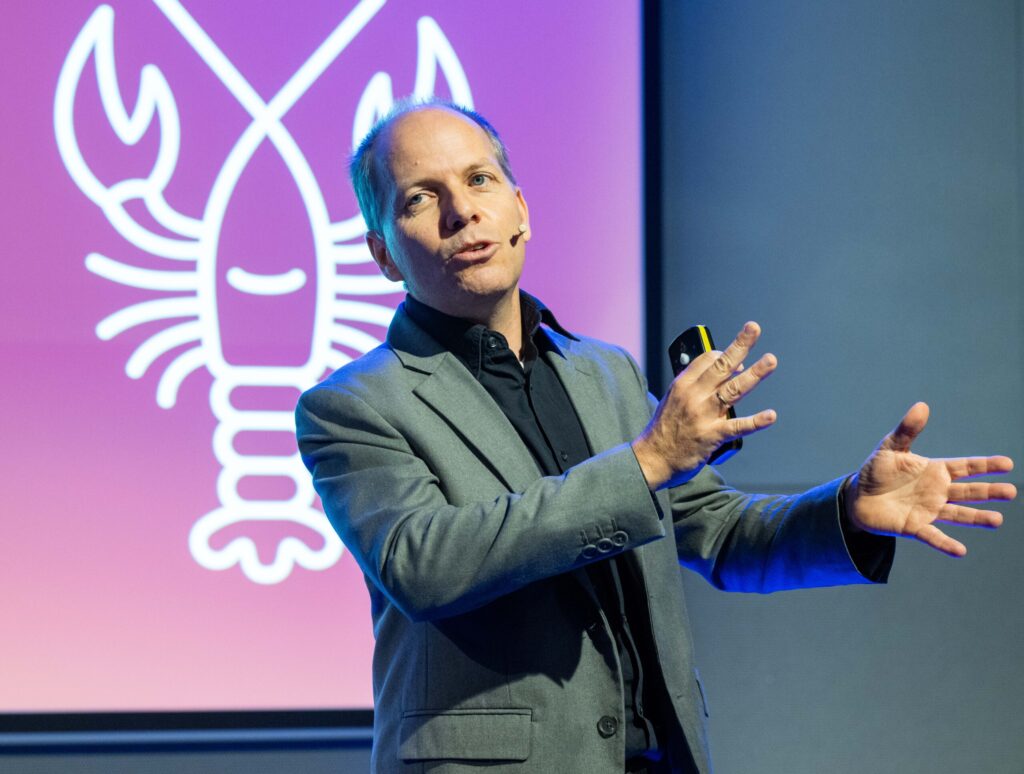
Your books use the lobster as a metaphor for transformation. What can organisations in the energy transition learn from The Lobster Strategy?
Almost everything, I would say – although I should probably explain that answer!
The lobster is a metaphor for real transformation. In my work I distinguish between Run, Change and Transform. Run is about optimising existing processes, routines and ways of working. Change means making more substantial changes: implementing new systems, redesigning structures or introducing new propositions. Transform is different. In transformation, the underlying system itself starts to change.
That is where the lobster becomes interesting.
A lobster can only grow by periodically shedding its shell. That shell has protected it and enabled it to survive. But eventually the very thing that protected the lobster becomes the thing that prevents it from growing further.
So it has to let go.
And once it has shed its shell, the lobster enters a period of extreme vulnerability. A new shell is already developing, but it takes time to harden.
Organisations face a very similar challenge. Existing technologies, business models, structures and routines have created enormous prosperity and success. We should acknowledge that. But circumstances can reach a point where something that served us extremely well in the past starts limiting our ability to move forward.
The challenge is therefore to build the new vehicle while gradually letting go of the old. And that is not a binary switch. Both processes have to take place in parallel.
The difficulty is that the existing business is always urgent. Customers call. Problems need to be solved. Targets have to be met. Meetings fill our calendars. The future, on the other hand, is incredibly important but rarely feels equally urgent.
So the danger is that organisations spend almost all their energy fighting today’s fires and too little preparing for tomorrow’s energy system. Not because people do not care about the future, but because the urgency of today continuously wins the competition for attention.
The problem is that transformation takes time. We cannot keep postponing something that may require years to build.
What development do you think leaders are currently underestimating?
I would perhaps answer this slightly differently. I think we underestimate the ability to collaborate across organisational and institutional boundaries as a critical capability for the energy transition.
Look at the major societal challenges we face: energy, housing, nitrogen emissions, climate change. We are not going to solve them if everybody stays on their own island defending their own territory.
Of course organisations have legitimate interests. Companies, governments and institutions cannot simply abandon those interests. I am not naïve about that. But somewhere along the way, every party will have to move beyond part of its own perspective.
The challenge is therefore not simply collaboration with the people who already understand the transition or who attend programmes such as ETBL. The real challenge starts when you return to your organisation and have to work with people who were not in that room.
How do you create common ground with people and organisations that may have different interests, incentives and perspectives? How do you find something you genuinely want together?
That is extremely difficult. But because the energy transition is a system transition, I believe this ability to cross boundaries is becoming one of the most important capabilities we need.
No single organisation, discipline or even country can solve this on its own.
What do you hope participants will do differently after your contribution to ETBL?
I am realistic: I spend roughly two hours with the participants, so I don’t expect the world to be completely different afterwards.
What I do hope is that they leave with a better understanding of the dynamics of transformation. That they can look at what is happening in their own organisation and say: “I understand better why this is happening. I recognise the patterns. And I understand my own role in them.”
I regularly hear participants say: “I wish I had known this three years ago, when we started our transformation. It would have saved me a lot of mistakes.”
That is exactly what I hope to provide: a bigger picture and some frameworks that help people understand where they are in a transformation and how they themselves relate to it.
My own contribution to ETBL has changed over the years as well. In the earlier editions, I focused much more on business models and the economic and strategic side of transformation. I still believe that is incredibly important. But the behavioural dimension has become much more prominent in my work.
That is because I have increasingly realised that the economic reality of an organisation is ultimately the result of what people do: the choices we make, the routines we hold onto, the risks we are willing to take and the things we are prepared to let go.
For years, I worked with organisations on strategies, plans and vision documents. Those are valuable because they help us articulate where we want to go. But ultimately, it is about walking the talk.
Are we actually going to get our boots muddy and start moving?
If you can help people recognise their motivations and their blockages, you can change behaviour. Different behaviour creates different choices. Different choices create different strategic decisions. And eventually, those decisions create different business models.
For me, those elements have become inseparable.
For what type of professional is ETBL particularly relevant right now?
I would say professionals who operate at the intersection of strategy, technology, markets and organisation.
Especially people who recognise that the energy transition can no longer be solved within their own discipline. That can include people working for energy companies, but equally professionals from industry, infrastructure, government or technology.
It is particularly valuable when participants have some responsibility for change within their own organisation. That makes the conversations much richer.
My sessions are deliberately interactive. I always say: the knowledge is already out there at the table. I can introduce frameworks, concepts and provocations, but the real value emerges when participants connect those ideas to what they themselves are experiencing.
When people are actually in the middle of these transformations, the discussion moves beyond theory very quickly. That is when learning becomes really interesting.
You have been involved with ETBL for around ten editions. What makes the combination of content, international locations and participants from different organisations so valuable?
The diversity is enormously important.
One of the most interesting things that happens in programmes like ETBL is that someone from a commercial company starts talking to somebody from government, infrastructure or another part of the energy system and suddenly realises: “Your world is completely different from mine, but actually we are struggling with remarkably similar questions.”
That matters because the energy transition is, by definition, a system transition. You cannot change a system from within one discipline or from the perspective of one organisation.
But there is another dimension that I find equally important: getting people out of their normal environment.
Transformation requires new experiences. You can listen to someone like me talking in a classroom, and hopefully I can make you rethink important issues at hand. But there is a difference between intellectually understanding something and actually experiencing it.
That is why the international locations and field trips are so valuable. Seeing what is happening elsewhere, meeting different people and experiencing different contexts does something that a presentation alone cannot do.
You can reach someone’s head by explaining something. You are much more likely to reach the heart when people can actually see and experience it.
And there is something else. If you remain in your normal job, surrounded by your normal colleagues, calendar and daily pressures, it is incredibly difficult to create the mental space needed for genuine strategic thinking.
Sometimes you have to be taken out of your own cocoon.
You need a different group of people around you. You need new knowledge, conversations with fellow participants, field trips and unfamiliar environments. Those experiences create space in your head and allow you to make connections that you might never make in the normal rush of everyday work.
That is also why connecting the programme to a participant’s own organisational challenge is so powerful. You are not simply collecting knowledge. You are using those new perspectives to work on something that matters in your own organisation.
That combination of distance, experience, diversity and application is, in my view, where the real value lies.
And perhaps that is why, after around ten editions, I still enjoy being part of ETBL. The energy transition keeps changing, the questions keep changing, and my own thinking continues to develop as well. For someone fascinated by transformation, I can hardly imagine a more interesting environment to work in.
About the Executive Energy Transition & Business Leadership programme
The Executive Energy Transition & Business Leadership programme (ETBL) brings together professionals from different organisations, sectors and backgrounds to explore the energy transition from technological, strategic, organisational and leadership perspectives.
Across several modules, participants step outside their daily working environment and learn in international settings including Amsterdam, Berlin and London, combining expert contributions with field visits, interaction with fellow participants and practical application. Even the journey itself becomes part of the learning experience, including a lecture while travelling by train.
An important element of the programme is the participants’ own organisational challenge. Throughout the different modules, they have time to develop their ideas, connect insights from the programme to their own context and work towards an Energy Essay, which is presented to the group during the final module in the London/Oxford setting.
As ETBL programme manager Eline Dietz- de Wagt explains, the intention is not simply to provide participants with more knowledge about the energy transition, but to give them the distance, inspiration and network to translate that knowledge into impact within their own organisation.